
Categories
Blogs

A Four-Step Guide to Learning “How to Pitch”

In my blog “The Art of Pitching,” I observed how the art of pitching has been disregarded with the rise in the culture of velocity. Throwing hard is not the end all be all. It reigns true time and again that pitchers who pitch win more than throwers

Pitching is a nuanced skill that goes beyond pure strength and velocity. It involves strategy requiring pitchers to learn how to execute their skills within the context of a game. Keeping hitters off balance, picking up the batter’s tendencies, and understanding the situation of the game are all skills that come with learning how to pitch. Here are four crucial steps that can help teach pitchers how to elevate their ability to execute.

  1. Assessing the pitcher’s arsenal

Before stepping on the mound, it’s essential for a pitcher to assess their own arsenal of pitches. This involves understanding the strengths and weaknesses of each pitch in their repertoire. Start with the pitcher’s raw stuff: pitch types, velocities, movements, spin rates, and location in the zone. Rapsodo or other technologies are great evaluative tools, as younger pitchers often have misconceptions about the true spin or movement of their pitches. 

Evaluating the pitcher themselves is also important in understanding their arsenal. What is their A, B and C pitch? How confident are they throwing inside? What is their best off-speed pitch? A thorough assessment allows pitchers to play to their strengths and identify areas to improve, to help bolster their pitch arsenal.

  1. Sequencing their pitches

Pitching is not just about individual pitches, it’s about the art of sequencing. The basics of sequencing is keeping hitters off balance through a combination of different pitch types, locations and speeds. The goal with each pitch is to make it more challenging for the hitter to anticipate the pitcher’s next move. 

This can be trained in bullpens by practicing different pitch combinations that would be commonly sequenced in games. Practice executing to both sides of the plate, throwing a fastball off of an off-speed pitch, or differentiating a two strike and a no strike off speed pitch. Incorporate pitch tunneling, where multiple pitches look similar initially but break in different directions late, making it harder for the hitter to anticipate. 

  1. Start introducing pitching in different counts

Once the pitcher has understood the basics of sequencing their pitches, it’s time to implement additional context that makes the execution more game-like. Adapting a pitcher’s strategy to different counts is crucial for success on the mound. In advantage counts, we want to work on attacking more aggressively to get the strikeout. In hitter’s counts, we want to focus on locating pitches in the zone to avoid free bases. 

With the additional context, pre-set count bullpens are a great way to work on executing pitches that a pitcher might not be comfortable with. In advantage counts, focus on throwing a competitive elevated fastball or off-speed pitch in the dirt. Hitter’s counts are almost always an automatic fastball in high school, so work on building confidence in throwing an off-speed pitch or changeup for a strike. Learning to navigate different counts effectively adds a layer of sophistication to a pitcher’s game.

  1. Test with simulated batters or live ABs

The final step is the practical application: testing the skills developed against simulated batters or live at-bats provides important feedback. The pitcher can gauge their progress, make real-time adjustments and build confidence in their ability to execute pitches in competition.  

Learning how to perform after failures and mistakes is the biggest test with live at-bats. Can they make adjustments off of a poorly executed pitch, reset their mind and execute the next pitch? Overall, this step bridges the gap between practice and game situations, preparing pitchers for the dynamic challenges they will face on the field.

Being a legitimate pitcher goes far beyond having the raw skills. It requires a strategic approach and understanding how to maximize your strengths. Implementing these steps in your off-season and in-season bullpens will help refine your craft and elevate your performance on the mound. 

Categories
Blogs

Character Traits That Make a Successful Ballplayer

No two baseball players are the same. Players have different skill sets, come from a variety of cultures, and bring unique personalities to a team. However, there are certain character traits that all successful ballplayers share no matter their background. Ken Ravizza and Tom Hanson breakdown of this concept in Heads-Up Baseball really clicked with me.

They highlight three character traits that all successful ballplayers have:

  1. Fun and enjoyment
  2. Respect for the game
  3. Pride and integrity in their work

I believe that fun and enjoyment is the most important trait because it sets the base. It’s the reason every athlete starts and keeps playing baseball. The younger version of yourself played baseball just because it was fun! You hung out with your friends, played games without a care in the world, and idolized the professionals on television. 

As the definition of fun/enjoyment changes throughout the years as the level of competition intensifies, successful players embrace it. If you don’t enjoy coming to the ballpark and putting the work in everyday, then your chances of excelling in baseball are minimal. There are many activities that are not exactly “fun”: 8am lifts, throwing in the off season when it’s cold outside, and taking the same repetition over and over until you get it perfect. The enjoyment of the game allows you to push yourself through those activities that you don’t want to do, but you need to do to excel. 

The second trait, respect for the game, takes on two definitions. The first is showing respect for the game through how you play. Chances are the player you respect the most is the one that respects the game. Every time they step on the field, they give it their all. They’re locked in for every pitch, at bat, and inning, ready for any opportunity that comes their way. Clayton Keyshawn, Ichiro Suzuki or Joey Votto come to mind when I think of players who respect the game. You don’t have to like them, but you have to respect the way they play.

The second definition of respect is recognizing that the game is difficult and committing to improving your skills. Like many things, having success in baseball does not happen overnight. Players that respect the game don’t waste their time or rely on shortcuts thinking that will get them to the finish line. Relying on quick-fix YouTube videos or “velocity hack” tips is not the way. You have to show up everyday with the intention of committing to the process and stacking days on top of each other.

The third trait that makes a successful ballplayer is pride and integrity in their work. Having pride in your work motivates you to prepare and play above your physical feeling that day. Take pride in your preparation and practice so you’re ready every single day. In Heads-Up Baseball, Pete Rose’s pride is used as an example. He was unbelievably consistent because he took pride in being the hitter he knew he could be everyday, and made sure that his practice was up to the standard he expected. This pride helped him put together a phenomenal 24-year career.

When it comes to the actual game, your pride and integrity goes into always playing hard. You know you worked to get stronger, faster, and develop new skills. And those skills deserve to be utilized to their fullest extent. Players with integrity recognize the hard work they’ve put in everyday and play to the level they’re capable of. If you ask yourself after a game “did I give it my all,” the answer should be a resounding yes, no matter how you feel physically going into the competition.

There are many other traits out there that make a successful ballplayer: leadership, mental toughness, composure, relentlessness just to name a few. Every player is truly different and will show strengths in certain traits over another. However, fun and enjoyment, respect for the game, and pride in your work set the foundation for all traits. Master these and you’ll give yourself the best shot to become the player you want to be.

Categories
Blogs

The Art of Pitching

It’s insane to see how the art of pitching is disregarded with the rise in the culture of velocity. I take in a lot of baseball – I’m a high school/travel coach who talks with other coaches and watches the MLB/college seasons. It’s my observation that the same story remains true year after year — pitchers that can pitch win more often than throwers. And for many younger players, learning how to pitch is not a priority.

Velocity receives so much attention across all levels of baseball, causing it to be singled out as the only way to grab eyes. It’s pervasive on social media. Pitchers just post their top fastball velocities from tournaments and showcases. College coaches recruit pitchers and bring in transfers that can pitch right away at high velocities. The same is true with pro ball where guys only get looks if they throw hard.

Why wouldn’t high school pitchers want to train for high velocity when it’s so glamorized? These pitchers want to throw as hard as possible and spin elite breaking balls because they think it equates to being a great pitcher. Don’t get me wrong, velocity and having good secondary pitches are very important to being a good pitcher. But it is far from enough if you want to be a great pitcher.

Velocity gets attention, but being able to pitch is what actually wins you ball games. Young pitchers need to realize how important it is to actually pitch. The two components of pitching are adapting to the game and working the strike zone. They have to know how to hold runners, pitch in different situations, and limit damage when innings go poorly.

Out of the two, working the zone is the most important component. It provides so many different looks that a hitter has to be prepared for. Reading a hitter’s swings, tunneling pitches, and throwing to all quadrants of the zone helps a pitcher stay in the game longer. Working the zone includes learning how to stay in the zone and pitch without your “A” stuff. Unfortunately, a byproduct of velocity-focused pitchers is a lack of control. Walks are killers. Walks halt momentum, losing the rhythm of the game for both you and the defense. Once a pitcher starts walking multiple hitters, their outings will be cut short.

I am watching a ton of postseason baseball and it’s obvious how important it is for starters to pitch deep into ball games. In 2022, teams were 21-6 when their starter pitched at least 6 innings, with five of those losses coming when the opposing pitcher also threw 6 innings. The same trend is present in the 2023 postseason, as we’ve seen multiple elite outings by starting pitchers in the first two rounds. 

These starting pitchers are working through stress, managing workloads, limiting walks, and collecting more outs for their team to limit the bullpen. Pablo Lopez (Minnesota Twins) is an excellent example with two great starts. In Game 2 of the ALDS, facing one of the most dangerous lineups in the playoffs, he worked all of his pitches throughout the zone. He also limited any opportunities the Astros had by walking only one batter over seven innings. Nathan Eovaldi (Texas Rangers)also had two outstanding starts against the Orioles and Rays, not walking any batters and allowing only three runners to get into scoring position combined across 13.2 innings.

Learning to pitch is the difference between being the pitcher your team just puts out there and a guy your team relies on in high pressure games. Great pitchers – high schoolers that pitch at the next level – want to be the one who takes care of business when called upon. Velocity and secondary stuff is important, but you’re missing out if that’s the extent of your focus on the mound.

Categories
Blogs

The 80% Rule

As a pitcher, it’s hard to make mechanical adjustments in a game, especially with the increase in stress that comes with competition. The game moves fast for those that don’t know how to slow it down, so you end up trying to make adjustments at a faster pace than you are used to. The only way to reset yourself is to slow the game down, but what does that actually look like?

The rule that I emphasize to pitchers is to lower their intensity to 80%. I believe 80% is the perfect balance of establishing your pace while keeping a competitive edge. Lowering your intensity does not mean you are losing focus or throwing 20% slower. For most players, the difference in velocity from their perceived relaxed 80% and tensed 100% might be a mile or two. The goal is to regain a consistent flow and rhythm in your mechanics. 

By lowering your intensity to 80%, you give your body time to feel fluidity through each point in your mechanics, from your leg kick to release. Instead of rushing to throw the ball, you can feel more relaxed in the load phase. The looser you are when you load, the more energy you can build up. Once you are able to regain a full range of motion, you can start gradually kicking up the intensity gradually to 100%.

The 80% rule is applicable when a new stress is presented that pushes you out of rhythm. It’s when you have that “the game is moving too fast” feeling. If your solution is to try to catch up to the speed of the game at 110% or 120%, you will lose consistency. Your body will start to tense at points in your mechanics that do not require tension to match the quicker pace you think you need. This opens up flaws –shortening your delivery, rushing down the mound, or putting more stress on the arm – because you are working at a pace that your body can’t handle.

A common time pitchers need to use the 80% rule is in the middle of a strenuous inning. However, one situation that doesn’t get enough attention where the 80% rule is applicable is the  start of a game. The first inning is one of the toughest innings for a pitcher, as they are entering a completely new environment.

No matter what your bullpen or warm-up pitches look like, once those first batters step into the box it’s totally different. Too many pitchers feel good in their bullpen, then jump into the game at 110% and walk the first two batters. Rather, they should treat the first batter like the new stress it is and utilize the 80% rule right from the beginning. Focus on finding your pace, feeling loose and smooth through your mechanics. Find the rhythm that works for you to settle into the game as early as possible. It might take a few pitches or even a batter to make this happen, but that first batter presents the lowest stakes of your entire outing to settle yourself in.

The 80% rule is even more important to a relief pitcher, whether they have a clean inning or are coming in during the middle of an inning. Treat that first pitch or two as your chance to find your rhythm. Obviously, as a reliever, you want to execute right away. The best chance you have to execute is in a familiar, comfortable rhythm. Once you find your rhythm and feel confident at 80%, you can start kicking up your pace to 100%.

The 80% rule is all about taking control of something you can control: your own pace and your mechanics. Instead of trying to think through complicated changes in a game, get your head out of the way. Take a deep breath, relax your mind, and let your body do what it knows how to do.

Categories
Blogs

Pitching Inside

If you want to be a competitive pitcher, you have to be able to throw inside to hitters consistently. Too many young pitchers neglect working a full half of the plate, limiting their overall effectiveness. Building confidence and having conviction to execute a pitch inside provides advantages that are necessary to be a stud pitcher.

Why are pitchers scared to throw inside? There’s two main reasons that pitchers are afraid to throw inside: they are afraid of hitting batters and giving up hits. Seeing the catcher set up so close to the hitter causes anxious thoughts to pop up in their head, creating  doubts in their ability to execute the pitch. The reality is if you throw inside, you will hit batters. That’s just an outcome you have to be okay with. There will always be negative consequences to missing a spot and hitting a batter isn’t the worst thing in the world. It hurts to get hit by a pitch, it leaves a bruise, and the hitter may be uncomfortable stepping into the box. 

It’s hard to hit an inside fastball. Reality check….hitters mostly hunt pitches over the plate they can extend on,  leaving the inner half more susceptible to missing their barrels. And even if they react to it and get extended, there’s a good chance they’ll pull it foul. By pitching inside, you’ll end up getting more jam shots off of the hands.

Why pitching inside is important.

Like I’ve alluded to earlier, pitching inside leads to a more uncomfortable at bats for the hitter. The hitter will just sit on pitches on the outer third if they know you’ll keep all of your pitches out there. Just throwing one pitch inside, decreases predictability to which location you might throw. Now the hitter has to respect the entire plate, opening up your ability to pitch outside effectively.

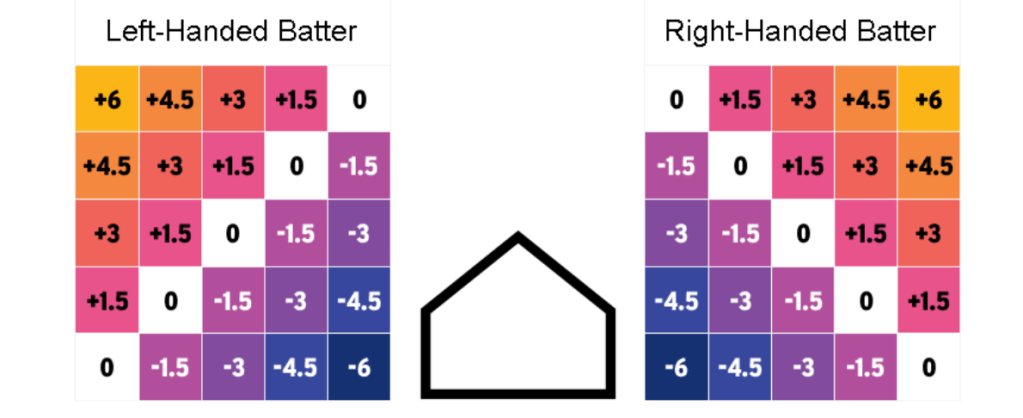
When hitters are aware of your inside pitch, you will have so many more options to sequence pitches by maximizing their effective velocity. Effective velocity is how fast the pitch appears when compared to the pitch that came before it. The location of the pitch changes how fast the pitch appears to the hitter because of how far they need to move their bat to make solid contact. Since a hitter has to meet the ball more out in front, an inside pitch’s effective velocity is higher than an outside pitch.

Image credits: teammstrd.com

A fastball in has the highest perceived velocity while an off-speed pitch away has the slowest. If you sequence those two pitches together, the effective velocity will be significantly greater than if you threw them to the same location. This will force the hitter to react to a greater speed difference, throwing off their timing on your pitches. You could also do the same with a fastball inside and outside. Even though both pitches might be the same speed, their effective velocity is different because you could throw inside.

Lastly, consistently pitching inside shows coaches a level of maturity that not many high school or even college pitchers possess. At one point or another, all pitchers feared throwing inside. Learning to throw inside shows your capacity to build mental skills where others would succumb to the fear. It’s not a flashy skill, like increasing your velocity or learning a new off speed pitch…everybody wants to be able to do that. But if I’m watching a pitcher and they are throwing inside with confidence, I know that they have put work into the actual craft of pitching.

Building confidence is the name of the game to get better at throwing inside. Find a mechanical cue or a focal point on the catcher, and rep it out until you are confident when that catcher sets up right underneath the hands of the batter. Getting over that fear is a giant step in changing from a thrower to a pitcher.

Categories
Blogs

Redefining Success

Success is an ever changing definition that can be impacted in numerous ways and needs to be continuously reevaluated. I see many players get discouraged when they have a tough start to a game and they ride that disheartened feeling for the rest of the game. If you want to bounce back in those situations, you have to understand how and when to adjust your definition of success.

Baseball has many different levels of battles. In the view of a single day, the game is the war, aka the accumulation of all of the battles you’ll fight throughout the day. Going into a game, you’ll have goals set or definitions of success that you will use to evaluate your performance post game. As a pitcher, it might be throwing five innings or only walking two batters. As a hitter, it might be collecting two hits or not striking out.

To achieve your goals, there will be many smaller battles you have to fight. You will need to plan how you will execute those battles to be successful for that game. 

I see players become disheartened when they start to lose small battles and evaluate their success while the game is still going on. This deters their performance for the rest of the game. In this case, you have to understand that while you are not pacing to achieve your overall goals, it does not mean that you have failed. 

Your next step is to adjust your definition of success to the new situation, and put your focus on achieving your brand new goal. You may have struck out twice, given up three runs on the mound or made an error in the field, but there is nothing you can do about that anymore. You hear coaches and teammates say “forget about it” or “have short term memory.” While it can be annoying to hear, it is valid advice! The only way you are going to move past the mistakes is to create this new plan and commit to it with the full belief you can still be successful.

Let’s say you are a relief pitcher and you want to throw a scoreless inning, but the first three batters reach base and now the bases are loaded with nobody out. Realistically, you are  not likely to complete this inning without giving up a run, and thinking about that will only make you try to pitch outside of your capabilities. In this situation, you need to create an attainable, positive goal such as playing to give up only one run, or maybe even two. Attack that new goal, one pitch and one batter at a time.

If you are a hitter and you are 0 for 3 with three strikeouts, you’re not going to make up for those earlier at bats or your goal of notching two hits. Rather than letting your last at bat get away from you, adjust your goal so you have something realistic to fight for. Success in this at bat might be as simple as working a walk or catching a barrel. 

Re-locking yourself in, even when the game has been stacked against you, gives your team the best chance to win. At the end of the day, baseball is a team sport and whether or not you achieve your goals for the game doesn’t directly correlate to your team winning. If you mentally check out of the rest of your opportunities, it will negatively impact your team. If you save the evaluation of your goals for after the game, you might find something from your extra effort that you’ll be happy with.

Categories
Blogs

Talk to Yourself, Don’t Listen

Nobody comes to the field everyday with 100%. You’ll show up feeling sore, tired, mentally exhausted, all of which are just the reality of the situation. Those feelings are not going to go away, but the moment you start listening to yourself you fall into trouble.

When you listen to yourself, you listen to how you feel or the negative thoughts that go through your head. Your brain’s purpose is to protect your body from reaching the point of failure, meaning that your mind wants to give up well before your body. To do that, your mind will tell you whatever it can to make you want to shut down. This should sound familiar to all of us, thinking back to situations where we’ve had to really push ourselves physically. If you’re getting near 100 pitches of a tough outing, on the back end of a summer double header, or maybe in the weight room during a hard workout, thoughts like, “I’m too tired,” “I’ve lost all feel for my mechanics,” “there’s no way I’m going to hit this pitcher,” “there’s no way I can get one more,” or “this is too hard” can creep into your head.

These are all negative thoughts that you hear when you listen to your body. Now, the moral to this story is not “just don’t listen to those negative thoughts.” The truth is that everybody has those bad, negative thoughts. Every athlete deals with them and you’ve probably dealt with thoughts like this playing other sports. You won’t be able to stop them because they are a part of the natural thought process. Like I said earlier, your mind is doing it to protect you.

Instead of trying to ignore them, our goal should be to acknowledge them. Be aware when you are having those thoughts and tell yourself that you don’t want to listen to them. Imagine if those thoughts in your head were another person, constantly telling you all of the negatives right to your face. Would you want that person around you? If they were telling you you can’t handle the pressure, you can’t execute that pitch, you can’t make that play…you would want to punch them in the face.

So why would we want to let those thoughts and feelings take over our mind? We don’t. After acknowledging them, we want to make sure we switch our mind from listening to talking. Too often we get caught listening to how we feel, listening to what already happened, or listening to that negative voice in our head trying to hold us back. In those moments, try talking to yourself. 

Switch your mind’s focus to the present with productive thoughts, focusing on your cues, positive affirmations, and things that you can control. Talk to yourself with such conviction that you truly believe what you are saying. Tell yourself that you are the best until you believe that you are the best! Tell yourself you can execute that pitch, you can field the next ground ball, you can hit this pitcher, even if you have missed the last 10 pitches or ground balls. 

Talk to yourself in whatever intensity you need to give yourself the energy to execute the task at hand. For some, it might be soft and relaxing. For others, it might be intense with a ton of expletives. Those intensities might change depending on the situation and the moment. It’s important for us to understand what we need to execute the very next task at hand, one pitch or play at a time.

Everybody’s subconscious mind, when they listen to it, will have negative thoughts. Your job is to differentiate the listening from the reality of the situation. The reality is that your present mindset is completely in your control. When you can flip the switch from listening to the negatives and talk to yourself about the great potential of the opportunities ahead, you’ll truly be able to maximize your skills.

Categories
Blogs

MOOMBA

Over the past few months, I’ve made it a habit to listen to at least two short, mental game podcasts per day. I’ve been able to learn about new concepts, listen to other’s experiences and find different ways that the podcast’s message could be utilized. Recently, a concept came up in two different podcasts that I’ve never heard before, but it just made sense to me. It’s called the MOOMBA Disease, which stands for “My Only Obstacle May Be Attitude.”

The biggest obstacle for yourself may be your attitude…what does that even mean? Your attitude is an active decision you make, no matter how unruly or tough of a circumstance. If you have a game in February when it’s 35 degrees with 20 mph winds, it’s really easy to let the cold weather get the best of your attitude. Thinking about how cold it is only magnifies the discomfort and negative thoughts, letting the environment take control of your attitude.

If you are somebody whose attitude is easily affected or if you are unaware when you have a bad attitude, you are putting yourself at a massive disadvantage. A bad attitude negatively affects your effort, emotion and minimizes your potential output. It doesn’t allow you to think clearly, and defaults you to making decisions and taking actions out of frustration.

Having a bad attitude is also contagious. You know what it’s like being around somebody who sulks for multiple innings after making an error or striking out. You don’t want to be near that person because their energy just drags you down with them. Instead, you want to be around people that are uplifting, that will push you to be your best and not pull you back. So why would you want to be that person with a bad attitude?

Your potential is truly only as strong as your attitude. Zig Ziglar, famous author and motivational speaker, once said, “your attitude, not your aptitude, will determine your altitude.” Your abilities (aptitude) could be second to none, but that is not the determining factor of your success. Strong aptitude combined with a poor attitude hinders how far and high you are able to go. It’s not until you remove that obstacle that you will be able to unlock your potential.

The key to maximizing your attitude is being able to hold yourself accountable and have the self awareness to know when you are losing control. Knowing that obstacle is there is a huge part of the battle, as many players need to have it pointed out to them. Once you have self awareness, you need to hold yourself accountable and take the actions to bring your attitude back within your control.

There are times where it is tough to have a great attitude. So imagine how hard it is to compete against somebody that does have a great attitude. Going back to our cold weather scenario, it’s already tough to play when it’s 35 degrees and windy. It’s even harder to play in those conditions if your opponent is excited to compete and confident in their abilities. Your opponent has now removed that obstacle and has a clearer lane to success. Again, your attitude is something you can control and have a direct impact over, so why forfeit its effectiveness to a force out of your control.

MOOMBA…My Only Obstacle May Be Attitude. There are already so many obstacles along the path to success. To battle the dreaded MOOMBA disease, realize the obstacles you are imposing on yourself and find ways to actively remove them. I challenge every player who’s reading this to buy into your attitude and practice building awareness so when the pressure is high, you are ready to bring your best self! 

——————————

If you’re interested in listening to short (2-4 minute), daily, mental conditioning podcasts, here are the three I highly recommend:

  1. Increase Your Impact with Justin Su’a | A Podcast for Leaders
  2. Success Hotline with Dr. Rob Gilbert
  3. Mental Performance Daily with Brian Cain
Categories
Blogs

Compete All the Time

Racing your siblings to the car, playing board games, seeing who can get a higher test score, fantasy football…competition is in everyday life. Everyone and their mother says they enjoy competition. However, there is a clear difference between those that like it purely for the result (winning) and those that truly have a passion for competing. These are the fake competitors versus the true competitors.

The fake competitors are the ones that want to compete when they know they can be successful putting in minimal effort and have a clear advantage over their opponent. As long as things are easy, they want to compete. We all know of players in Little League, high school and even college who can just show up, shut everybody down and leave. 

However, once adversity hits them and their natural talent can’t support them, they crumble. They give up a few hard hit balls and everything unravels. Their confidence goes away, they lose control and the only way to make it stop is to take them out of the game. While these players have the natural talent to succeed at one level, they’ll watch as others slowly pass them until they don’t have the talent to compete and quit.

The true competitors are the ones that pass them. True competitors love competition, even if the odds are stacked against them. They want to continue competing when they’re down big in a game, when they’re playing a tough opponent and when they’re clearly outmatched. While these situations may seem extremely hard to win, the fact that there is even a slight chance to do so makes it worth the effort. 

As a coach, it is fun to see these qualities play out. You can see which players will give the effort when you’re down 6-0 in the 2nd inning versus the best team in your conference. You see who folds first and who doesn’t stop fighting until that last out is recorded. You see who  fights until the competition is actually over.

Anybody will admit it’s hard to be a true competitor all of the time, especially against the biggest challenges. If you want to transition from being a fake to true competitor, or become an even better true competitor, you need to learn how to compete all of the time. You have to play hard no matter the situation, no matter how much you are losing or how miserable the competition is. To compete all of the time, you have to find those smaller battles to compete for. 

You are not going to make up a big deficit with one swing, but you can move yourself in the right direction with it. A true competitor will break down the game into mini, controllable competitions that allow them to chip away at the large competition. They focus on executing a single pitch, getting ahead in the count, fielding the ground ball coming at them. This removes the distractions and negative thoughts that could come in competition. It directs their focus to beneficial tasks and confines their thoughts to what can help them succeed.

Breaking down the game is essential to use all of the time, not just when you are playing a tough team or losing. As a pitcher, focusing on one pitch at a time and executing that plan is what gets you into a “groove.” If you miss a few pitches or walk a batter, avoid letting the game unravel by refocusing your mind to the small competition. True competitors are great at finding and re-finding those “groove” states.

Coaches want to put the best competitors on the field. They want the players who will fight when it’s tough and rise to the occasion. If you want to be that true competitor on the field, learn to compete all of the time by attacking the small battles. There is only one way to eat an elephant: one bite at a time.

Categories
Blogs

Learn By Watching

If you want to play at a high level, you have to watch professional or college baseball. It baffles me to hear that players who aspire to be the best don’t watch the best. Like many kids, I fell in love with baseball by watching Major League Baseball because I admired the best of the best. My love for watching the game evolved with my baseball IQ, going from admiring to mimicking to analyzing.

I grew up watching the Boston Red Sox, since my t-ball team was the Red Sox, and the Washington Nationals once they came to town. Dustin Pedroia and Ryan Zimmerman were my favorite players in the league. I even had metal lunch pails with their faces on them to collect my baseball memorabilia. Both players were absolute studs but they grabbed my attention for different reasons.

Pedroia was an undersized middle infielder who took the world by storm winning Rookie of the Year and MVP in back to back years, leading his team to the World Series. I loved his grittiness and the impact he had on a winning team. On the other hand, Zimmerman was developing into the face of a new franchise, setting his mark early in his career at a stadium only 20 minutes from where I lived. I admired both of them and since they were on different teams, I got to watch twice the baseball with that spirit. They helped drive my passion to play baseball at such a young age.

As I got into my early high school days, my pure admiration for players started to shift into thinking about how I could be like them. Bryce Harper was my guy when he broke into the league around my 8th grade year. His passion, grittiness and hair-on-fire intensity paired with his elite talent made me want to figure out how I could do what he did. I tried to replicate his intensity and tendencies at the plate, mimicking his stance, the intensity of his swing and even rocking with one batting glove just because he did it. I wanted to find the things he did well and incorporate them into my game. He was the beginning of me wanting to analyze major leaguers to aid in how I played.

I really laid into the analysis during high school and college as I dedicated myself more to pitching. When Max Scherzer signed with the Nationals, I had easy access to watch the best pitcher of the time work every five days. At face value, people would watch him for his elite competitiveness and his nasty pitches, but I wanted to learn more. I watched his sequencing, his approach, how he held runners, when he’d empty the tank and everything else I could pick up.

To learn from the best, you have to watch with a sense of curiosity that digs deeper than what the average fan pays attention to. By flipping on the television, you have a front row seat to watch the best movers. These are the players with elite pitches, that make elite plays and have elite swings. How are these players so damn good? There are so many nuances to pick up on in an MLB game. The action of the game doesn’t tell the entire story.

How do they prepare? Watch their first step on defense, their approaches in the field and at the plate, their between pitch routine. How do they create their focus? How do they make in-game adjustments? Watch the catcher’s pre-pitch movements and set up. Watch the adjustments the fielders make based on the hitter or the game situation and how they communicate. Watch the hitter’s preparation in the on-deck circle. Watch how long the pitcher holds with runners on base to keep the base runner uncomfortable.

If you play baseball but think it’s too boring to watch, you just don’t know what you’re looking for. There’s a massive learning opportunity in watching a game. You don’t have to pay for a lesson or work with a coach to gain this information. It stems from your curiosity in figuring out how you can take what the best of the best do and apply it to your own skill set.