

My main focus this year when working with my high school pitchers was getting ahead early and often. At every level of baseball, the worst innings usually happen when the pitcher falls behind in counts or walks hitters. This is especially true at the high school level, where pitchers tend to either get too picky with their spots or have trouble making adjustments to get back in the zone. To combat this issue, I attacked it from two different angles: emphasized the importance of early strikes and adjusted how our catchers set up.
In college, we charted a statistic called “2 by 3s,” which is how many times the pitcher threw two strikes in the first three pitches. Combined with tracking first-pitch strikes, these two stats are great indicators of how aggressive our pitchers are early in the counts. In my opinion, the 1-1 count is the most important in an at bat because of how swayed the hitting statistics are based on the result of the following pitch. When looking at Major League Baseball data, that advantage is significant.
The graph below shows the batting average (BA), on base percentage (OBP), and on base plus slugging (OPS) after 1-1, 1-2, and 2-1 counts in the MLB during the 2021 season. After a 1-1 count, there is a .165 difference in OBP and a .302 difference in OPS. In a 1-2 count, a hitter’s BA drops to .169, which is 75 percentage points below the league average. The OPS difference stands out the most, as it shows that when the pitcher gets ahead, there is a lower chance that the batter reaches base and a lower chance the batter hits the ball hard/reaches via an extra base hit. Statistically, the 1-1 pitch is the most significant as the OPS difference is the greatest out of any single pitch, even beating the 0-0 pitch by over 90 percentage points.
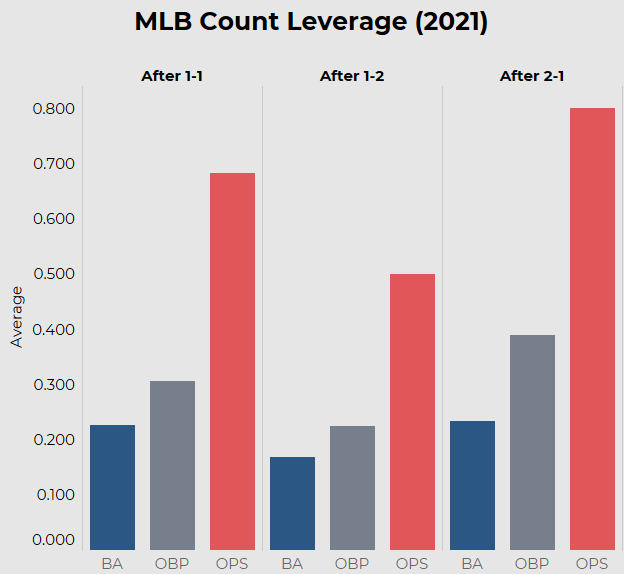
No matter the significance, this trend is present across all counts. But the significance of getting ahead early is prevalent as it decreases the risk of falling behind later in the count. With these statistics in mind, I challenged my pitchers this year to be fearless in getting two strikes in the first three pitches. That did not mean throwing pitches down the middle so they don’t miss the strike zone. I wanted them to be confident in their ability to work the inner and outer half of the plate.
However, I noticed that we were still running into issues of pitchers falling behind because they were not getting calls when they missed their target by small margins. Pitchers were getting the ball inside, which is a challenging location to be comfortable with as underclassmen, but were still missing too far inside or missing up in the zone. While the pitchers were being aggressive, maybe the catcher’s setup wasn’t maximizing their potential to get strikes on missed locations.
An article by the Baltimore Sun discusses how the Baltimore Orioles’ catchers have been setting their initial target up down the middle of the plate this season as opposed to starting at their desired location. The whole idea was to get their pitchers ahead in the count and not focus on nitpicking their strikes or being too perfect. With this adjustment, the Orioles’ strike percentage had increased to 52.9% over the first two weeks of the 2022 season, which was the highest in the MLB and a higher percentage than any season for the Orioles since the beginning of the Statcast era in 2008.
This setup benefitted MLB pitchers because a lot of those arms have fastballs in the mid to upper 90s and plus off-speed pitches. Rather than pitching to corners and trying to be perfect, they would let the spin of the pitch work over the plate. Their pitchers still found themselves inducing weak contact, and getting swings and misses. While our high school pitchers don’t possess the tools of pro pitchers, high school hitters don’t have the tools of pro hitters either. By throwing a strike over the plate, there’s a higher chance a high school hitter will still get themselves out.
With that in mind, I implemented a variation of what the Orioles did with our catchers. I had our catchers setup with their outside knees on the black so their entire body frame was on the plate, whether that be on the inner or outer third of the plate. That way we were guaranteed to get strikes within the frame of the catcher, the catcher could effectively reach the strike across the plate to steal missed spots, and, with a high school strike zone, we could still get calls on pitches just off the plate. When we got to two strikes, I allowed our catchers to expand and “get a little greedy.”
By combining the catchers setting up on the plate with our pitchers focused on being aggressive in the zone early, we achieved the results we were looking for. We were getting a higher percentage of first pitch strikes and 2 by 3s from our pitchers. While we were hitting our intended spots a little more, our misses were generating more strikes.
The comfort of getting those strikes allowed our pitchers to be more aggressive with their pitch usage. Many high school pitchers rely on throwing first pitch fastballs to get ahead and that’s what high school hitters expect. Building our pitchers’ confidence that they could get ahead early opened them up to trusting their off-speed pitches earlier in counts, or even a good fastball inside. There were very few times that our pitchers threw first pitch off-speed pitches that were hit hard. A majority of them were either taken/swung through for strikes or were weak contact.
Once they got ahead, I wanted our pitchers and catchers to be greedy and get their outs right away. They needed to go after the hitter with competitive two strike pitches, as opposed to the staple elevated fastball that sails too high (great pitch in theory, but not practiced enough to execute properly). Instead, they threw competitive off-speed pitches in the dirt or off the plate, and even tried to put guys away with fastballs just a little more outside. The combination of us getting ahead early and a high school umpire’s tendency to give at least a ball off the plate, allowed us to execute fastballs out of the zone to get our outs.
My number one goal with any pitcher is to set them up to be confident when they step on the mound. Confidence is built in preparation and past success. By emphasizing being aggressive in the zone during mound work/pre-game bullpens, they prepare themselves for success. Once they execute working ahead in counts consistently and feel comfortable doing so, they gain that confidence. Overall, these tactics increased our pitchers’ confidence so they could continue to be aggressive outing after outing.
 Painting Corners Blog