
In any competition, maximum focus is necessary to ensure the highest quality of performance. In a sport like baseball that some people describe as “slow” and “uneventful” (everybody has their own opinion, but they are wrong), focus is still necessary for high-stress situations. We have complete control over our focus. Understanding the different levels of focus and how to train your focus will improve your performance in the heat of competition.
Your level of focus directly correlates with the potential of action or the level of stress in a situation. Mistakes happen primarily when our focus does not line up with the situation. Your preparation, skill, and ability have nothing to do with those mistakes. It is purely the focus. This applies to more than baseball.
In aviation, for example, there is a rule related to focus called the cockpit rule. In 1981, the Federal Aviation Administration (FAA) reviewed a series of accidents caused by the flight crew being distracted from flying duties. They found that a majority of accidents happened below 10,000 feet, the most critical part of the flight, due to “non-essential conversations” and activities. As a result, the FAA imposed this rule, stating that only conversations related to the flight itself are allowed below 10,000 feet to ensure the highest focus during essential action. When an airplane surpasses 10,000 feet, conversations can relax since there is a low chance of error.
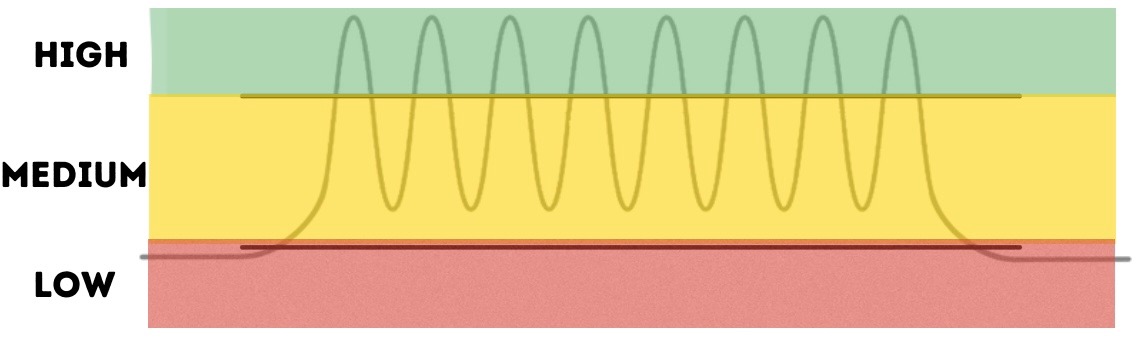
So how can this rule relate to baseball? Both aviation and baseball have times of high focus and low/medium focus, even if they flow differently. When you are in those essential situations in baseball, you need to hold your focus accountable just like a pilot. Stepping in the box, getting on the rubber, or prepping for the pitch in the field is the equivalent of being under 10,000 feet when flying a plane. Those moments require 100% of our attention to minimize error.
The medium focus moments are the other time we are in the field in between pitches. We still need to assess the last pitch, have conversations with ourselves to prepare for the next pitch, and come back to high focus, but there is a lesser chance of immediate error. For comparison, medium focus when flying a plane is at cruising altitude: it is the smoothest part of the flight, but issues like turbulence can still come up.
Low focus moments are in between innings or when you are not involved in the game. As a pilot, the equivalent is the plane on the ground and at the gate. In both examples, there are no errors to make because it is in between the essential action.

Being able to hone in your focus in high-intensity situations looks like it just happens for the best of the best. Pitchers like Max Scherzer and Justin Verlander can turn it up to a different level in the backend of their starts when fatigue sets in and the outs are more important. However, players like them do not get to that level of focus overnight.
Just like any skill, quality repetitions and practice helped them improve their focus. Low-risk reps, such as throwing a bullpen, taking batting practice, or fielding ground balls, can be used to hone your in-game focus. Hold yourself accountable. Use these times to train your focus by practicing quick adjustments in low-pressure situations so you are prepared to make them in high-pressure ones.
Let’s say you are throwing a bullpen and you want to work on executing your offspeed pitch late in counts. You need to put yourself in that game-like mindset, envisioning the batter in the box staring you down and the catcher flashing you signs. Focus on your breathing, cues, and self-talk to make sure you execute that pitch with a game-level intensity. You have time in that bullpen to work on hitting your spot, but once you get in a game, you have one chance to execute a 1-2 offspeed pitch in the 7th inning with the bases loaded. Focusing and throwing four well-executed offspeed pitches in a bullpen is a lot better than throwing ten pitches in one minute.
Different moments in a game require different levels of focus. You do not need to be 100% focused the entire time. Honestly, that is just a waste of energy. However, as I have said over and over so far, we have to be able to turn it up when the situation calls. By practicing and understanding your level of focus, it will subconsciously increase when the moment calls for it, priming you for success.
 Painting Corners Blog